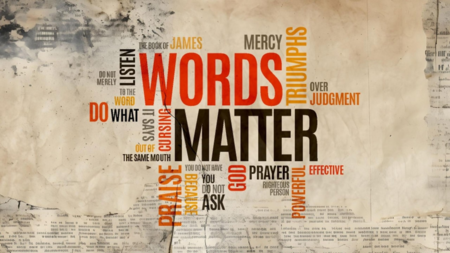
Over the last couple of weeks, we've been talking about how words matter, what they are, how they can affect us, and what happens with words. There was a song that I learned when I was a little kid—I don't remember if it was particular to Sunday school or if it was just my grandfather that taught me—and one of the lines was, "Be careful little mouth what you say," because the words we say are important. They affect us, bring about either positive or negative outcomes in what we do, and show us how to effectively use the words we have.
Some of the words that we come across can be sort of strange. Does anybody know what this word is: sesquipedalian? Basically, it is a long word meaning a person who uses long words, or the long word itself. And then there is fudgel. It's basically an old slang term for pretending to work when you're actually doing nothing. How about this one: noctivagant? It has to deal with wandering around in the night. That's a big word for something really small. Pandiculate means the act of stretching yourself while yawning. And then dysania—this one is typically experienced by kids on weekdays and by adults on Sunday mornings; it's the state of finding it exceptionally hard to get out of bed in the morning.
Words can be difficult to understand, use, or pronounce to get the correct meaning. Especially in the English language, words can have double meanings. Like the word "for"—it can mean "in order to" or "because of". Saying "I'm going to the grocery store for milk" means I'm going to get some, not that I have gotten it. It could also apply to a man that was "wanted for murder". It's not that you're wanting to hire him to have somebody murdered; it's that he has committed the act. There's a story of an old cowpoke who rode into town, saw a sign on the sheriff's door that said "Man Wanted for Robbery," and went in and said, "I've got two six-guns, I'll take the job!"
How we understand what we say and how we use words are so important. That's why it's important for us to watch our words as we get into James chapter 3 today.
One of the words that sounds smooth and poetic is malevolent. It rolls off the tongue and makes you feel good, right? But actually, it means wishing to harm others or showing a desire to be cruel. Something can sound like one thing and be totally something else.
Scripture gives us an idea of this kind of speech. Proverbs 12:6 tells us, "The words of the wicked are like a murderous ambush, but the words of the godly save lives." It depends on how we use our words as to what is going to take place.
Jesus said it this way in Matthew chapter 12: "You brood of snakes, how could evil men like you speak what is good and right? For whatever is in your heart determines what you say. A good person produces good things from the treasury of a good heart, and an evil person produces evil things from the treasury of an evil heart. And I tell you this, you must give account on judgment day for every idle word you speak. The words you say will either acquit you or condemn you."
Jesus talks so much about words and how we use them. I invite you to turn with me to James chapter 3, beginning at verse 1:
"Let not many of you become teachers, my brethren, knowing that as such we will incur a stricter judgment. For we all stumble in many ways. If anyone does not stumble in what he says, he is a perfect man able to bridle the whole body as well. Now if we put the bit into the horse's mouth so that they will obey us, we direct their entire body as well. Look at the ships also: though they are so great and are driven by strong winds, they are still directed by a very small rudder wherever the inclination of the pilot desires. So it also is with the tongue; it is a small part of the body, yet it boasts of great things. See how great a forest is set aflame by such a small fire! And the tongue is a fire, the very world of iniquity. The tongue is set among our members as that which defiles the entire body, and sets on fire the course of our life, and is set on fire by hell itself. For every species of beasts and birds and reptiles and creatures of the sea is tamed and has been tamed, but no one can tame the tongue. It is a restless evil and full of deadly poison. With it we bless our Lord and Father, and with it we curse men who have been made in the likeness of God. From the same mouth come both blessing and cursing. My brethren, these things ought not to be this way. Does a fountain send out from the same opening both fresh and bitter water? Can a fig tree, my brethren, produce olives, or a vine produce figs? Nor can salt water produce fresh."
He mentions "perfect" in verse 2. What does it mean to be perfect? James tells us in chapter 1, verses 2 through 4: "Dear brothers and sisters, when troubles of any kind come your way, consider it an opportunity for great joy. For you know that when your faith is tested, your endurance has a chance to grow. So let it grow, for when your endurance is fully developed, you will be perfect and complete, needing nothing." Even the hurts, trials, and testing grow us into a place where we are becoming fully developed and mature.
"Perfect" does not mean what we usually think—without flaw, blemish, or sin. Only Jesus was ever perfect by that definition. If a child draws you a picture of their family with stick figures, balloon heads, and seven fingers on each hand, you say, "Oh, this is wonderful; this is just perfect," because it met the purpose and was the best they could do.
The New Living Translation translates James 3:2: "Indeed, we all make many mistakes. For if we could control our tongues, we would be perfect and could also control ourselves in every other way."
Psalm 39:1 says, "I said to myself, 'I will watch what I do and not sin in what I say. I will hold my tongue when the ungodly are around me.'"
Our words do more than just come out of our mouth; they give us direction. When directing traffic, you try to get people to follow directions. People often want to go their own way, thinking it is best, only to get into trouble. Our words direct our lives.
In verse 3, James says bits in horses' mouths direct their whole body. Psalm 32:9 says, "Don't be like a senseless horse or mule that needs a bit and bridle to keep it under control." In verse 4, he speaks of ships directed by a very small rudder. The tongue is like a bit or a rudder; that power of direction should not be taken lightly.
If you drive a nail into a board and pull it out, the wood does not go back to the way it was—it leaves a hole. Words said in haste or anger leave an impact, and even if we apologize, what has been said cannot simply be erased.
Before I became a pastor, back in 1997 or 1998, I received a birthday card from an elderly lady in our church while I was wrestling with God about entering ministry. She wrote, "Don't you think it's time that you finally became a pastor?" Her words influenced me deeply. Our speech has the potential to lead others toward God or steer them away. The same applies to self-talk. Are we telling ourselves that we are worthless, or that we are made in the image of God?
Not only can words direct us, they can also destroy us. In verse 5, James writes, "See how great a forest is set aflame by such a small fire." A tiny spark causes massive forest fires.
Proverbs 26:20 tells us, "Fire goes out without wood, and quarrels disappear when gossip stops." Proverbs 16:27–28 says, "Scoundrels create trouble; their words are a destructive blaze. A troublemaker plants seeds of strife; gossip separates the best of friends." Psalm 64:3 speaks of those who "sharpen their tongues like a sword and aim bitter speech as their arrow."
James 3:6 says the tongue "sets on fire the course of our life, and is set on fire by hell." Proverbs 4:23–27 tells us, "Guard your heart above all else, for it determines the course of your life. Avoid all perverse talk; stay away from corrupt speech. Look straight ahead and fix your eyes on what lies before you. Mark out a straight path for your feet and stay on the safe path. Don't get sidetracked; keep your feet from following evil." Revelation 20:15 describes hell as the lake of fire.
In fire prevention, we create defensible space, cut weeds, and water the lawn to keep it moist and green. How does that apply to our speech?
- Defensible Space: Who are you hanging out with? Is there space between you and corrupt speech or bad influences?
- Cutting Weeds: What are you allowing to grow unchecked? Hebrews 12:15 warns, "Watch out that no poisonous root of bitterness grows up to trouble you, corrupting many."
- Watering the Lawn: Are we watering our hearts so they flourish rather than dry out and burn? 2 Thessalonians 3:5 says, "May the Lord lead your hearts into a full understanding and expression of the love of God and the patient endurance that comes from Christ." Ephesians 3:17 says, "Your roots will grow down deep into God's love and keep you strong." We water our spiritual life through regular Scripture reading, prayer habits, and fellowship with believers.
James 3:7–8 tells us that every kind of animal has been tamed, but "no one can tame the tongue. It is a restless evil, full of deadly poison." Psalm 140:3 says, "The poison of a viper is under their lips."
Finally, words display what is in our hearts. Verses 9–10 remind us that with the tongue we bless our Lord and Father, and with it we curse people made in His likeness. "My brethren, these things ought not to be this way."
Jesus said in Matthew 15:11, "It is not what goes into the mouth that defiles a person, but what comes out of the mouth; this defiles a person." In James 3:11–12, he asks if a spring pours forth both fresh and salt water, or if a fig tree can bear olives. A divided heart sends out conflicting words.
Our words are a reflection of what is truly inside us. Luke 6:45 says, "For from the overflow of the heart, the mouth speaks." We cannot consistently speak good words from a corrupt heart; transformation of speech must begin with the transformation of the heart.
People often say, "That's just the way I am." But 1 Corinthians 6:11 says, "Some of you were once like that, but you were cleansed, you were made holy, you were made right with God by calling on the name of the Lord Jesus Christ and by the Spirit of our God."
James 1:26 states, "If anyone thinks himself to be religious yet does not bridle his tongue but deceives his own heart, this man's religion is worthless." Jesus said in Matthew 7:20, "Yes, just as you can identify a tree by its fruit, so you can identify people by their actions."
What do your words say about your heart? Are you speaking both freshwater and saltwater?
Let us pray:
Father, we thank You. Work in us to make us what You want us to be—to cleanse us, change us, and make us more like You. Give us strength and wisdom to trust You with our words, knowing they give direction, have the power to destroy, and display what is in our hearts. Help us reflect Christ in all we say and do. In Jesus' name we pray, Amen.